Badges |
|
|---|---|
Packages and Releases |
|
DOI |
|
Build Status |
|
License |







Overview
ParaDigMa (Parkinson’s disease Digital Markers) is a Python toolbox for extracting validated digital biomarkers from wrist sensor data in Parkinson’s disease. It processes accelerometer, gyroscope, and PPG signals collected during passive monitoring in daily life.
Key Features:
Arm swing during gait analysis
Tremor analysis
Pulse rate analysis
Scientifically validated in peer-reviewed publications
Modular, extensible architecture for custom analyses
Quick Start
Installation
For regular use:
pip install paradigma
Requires Python 3.11+.
For development or running tutorials:
Example data requires git-lfs. See the installation guide for setup instructions.
Basic Usage
from paradigma.orchestrator import run_paradigma

# Example 1: Single DataFrame with default output directory
results = run_paradigma(
    dfs=df,
    pipelines=['gait', 'tremor'],
    watch_side='left',  # Required for gait pipeline
    save_intermediate=['quantification', 'aggregation']  # Saves to ./output by default
)

# Example 2: Multiple DataFrames as list (assigned to 'df_1', 'df_2', etc.)
results = run_paradigma(
    dfs=[df1, df2, df3],
    pipelines=['gait', 'tremor'],
    output_dir="./results",  # Custom output directory
    watch_side='left',
    save_intermediate=['quantification', 'aggregation']
)

# Example 3: Dictionary of DataFrames (custom segment/file names)
results = run_paradigma(
    dfs={'morning_session': df1, 'evening_session': df2},
    pipelines=['gait', 'tremor'],
    watch_side='right',
    save_intermediate=[]  # No files saved - results only in memory
)

# Example 4: Load from data directory
results = run_paradigma(
    data_path='./my_data',
    pipelines=['gait', 'tremor'],
    watch_side='left',
    file_pattern='*.parquet',
    save_intermediate=['quantification', 'aggregation']
)

# Access results (nested by pipeline)
# For gait, results are nested by filtered/unfiltered
gait_filtered = results['quantifications']['gait']['filtered']
gait_unfiltered = results['quantifications']['gait']['unfiltered']
tremor_measures = results['quantifications']['tremor']
gait_aggregates = results['aggregations']['gait']  # Contains 'filtered' and 'unfiltered' keys
tremor_aggregates = results['aggregations']['tremor']

# Check for errors
if results['errors']:
    print(f"Warning: {len(results['errors'])} error(s) occurred")
See our tutorials for complete examples.
Pipelines
Validated Processing Pipelines
Pipeline |
Input sensors |
Output week-level aggregation |
Publications |
Tutorial |
|---|---|---|---|---|
Arm swing during gait |
Accelerometer + Gyroscope |
Typical, maximum & variability of arm swing range of motion |
||
Tremor |
Gyroscope |
% tremor time, typical & maximum tremor power |
||
Pulse rate |
PPG (+ Accelerometer) |
Resting & maximum pulse rate |
* Indicates pre-print
Pipeline Architecture
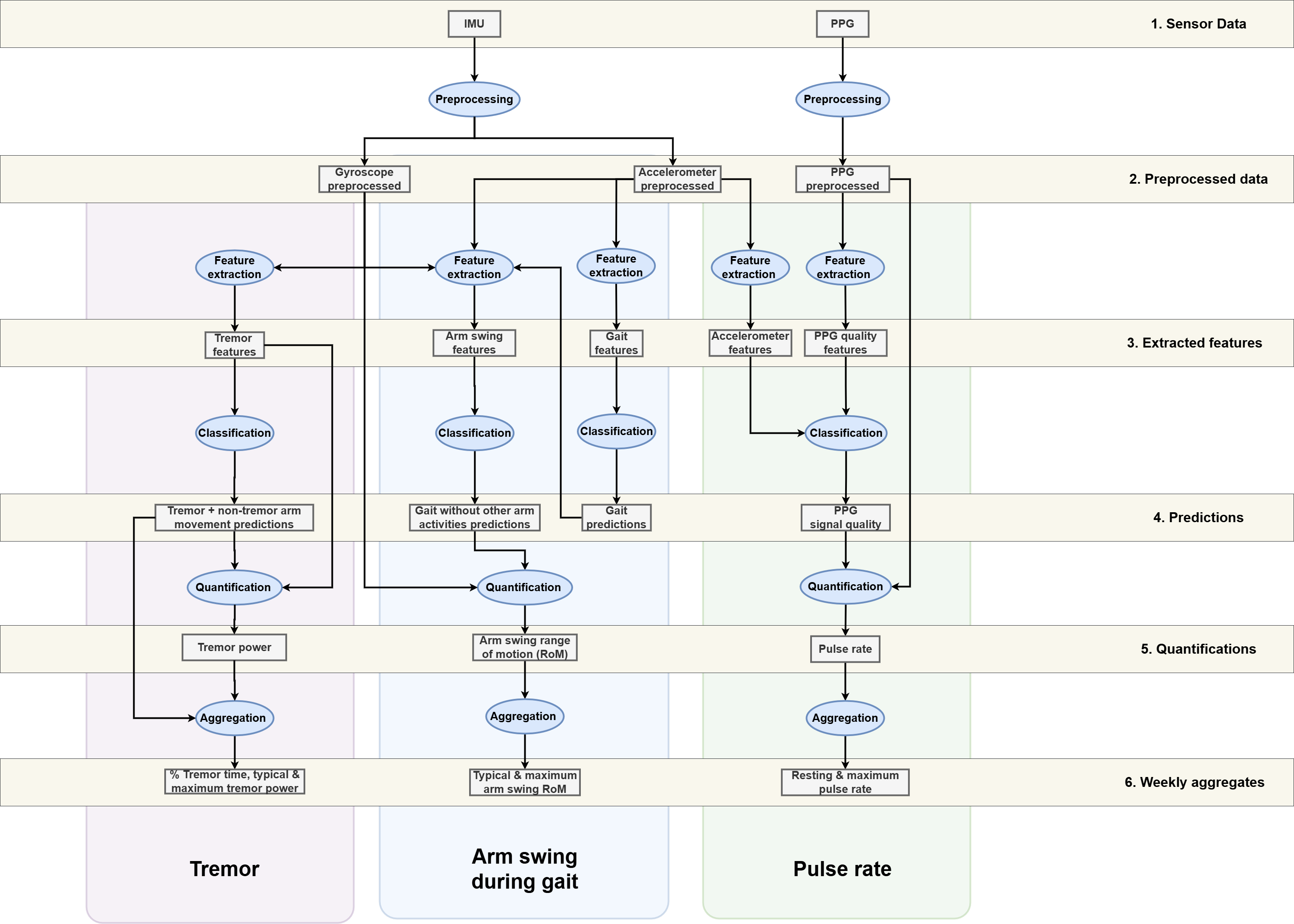
ParaDigMa can best be understood by categorizing the sequential processes:
Process |
Description |
|---|---|
Preprocessing |
Preparing raw sensor signals for further processing |
Feature extraction |
Extracting features based on windowed sensor signals |
Classification |
Detecting segments of interest using validated classifiers (e.g., gait segments) |
Quantification |
Extracting specific measures from the detected segments (e.g., arm swing measures) |
Aggregation |
Aggregating the measures over a specific time period (e.g., week-level aggregates) |
Usage
Documentation
Tutorials - Step-by-step usage examples
Installation Guide - Setup and troubleshooting
Sensor Data Requirements - Data specifications and compliance
Supported Devices - Validated hardware
Input Formats Guide - Input format options and data loading
Configuration Guide - Pipeline configuration
API Reference - Complete API documentation
Sensor Requirements & Supported Devices
ParaDigMa is designed for wrist sensor data collected during passive monitoring in persons with Parkinson’s disease. While designed to work with any compliant device, it has been empirically validated on:
Verily Study Watch (gait, tremor, pulse rate)
Axivity AX6 (gait, tremor)
Gait-up Physilog 4 (gait, tremor)
Empatica EmbracePlus (data loading)
Please check before running the pipelines whether your sensor data complies with the requirements for the sensor configuration and context of use. See the sensor requirements guide for data specifications and the supported devices guide for device-specific setup instructions.
Data Formats
ParaDigMa supports the following data formats:
In-memory (recommended): Pandas DataFrames (see examples above)
Data loading file extensions: TSDF, Parquet, CSV, Pickle and several device-specific formats (AVRO (Empatica), CWA (Axivity))
Troubleshooting
For installation issues, see the installation guide troubleshooting section.
For other issues, check our issue tracker or contact paradigma@radboudumc.nl.
Scientific Validation
The following publications contain details and validation of the pipelines:
Arm swing during gait
Tremor
Pulse rate
Contributing
We welcome contributions! Please see:
Citation
If you use ParaDigMa in your research, please cite:
@software{paradigma2024,
  author = {Post, Erik and Veldkamp, Kars and Timmermans, Nienke and
            Soriano, Diogo Coutinho and Kasalica, Vedran and
            Kok, Peter and Evers, Luc},
  title = {ParaDigMa: Parkinson's disease Digital Markers},
  year = {2024},
  doi = {10.5281/zenodo.13838392},
  url = {https://github.com/biomarkersParkinson/paradigma}
}
License
Licensed under the Apache License 2.0. See LICENSE for details.
Acknowledgements
Core Team: Erik Post, Kars Veldkamp, Nienke Timmermans, Diogo Coutinho Soriano, Vedran Kasalica, Peter Kok, Twan van Laarhoven, Luc Evers
Advisors: Max Little, Jordan Raykov, Hayriye Cagnan, Bas Bloem
Funding: the initial release was funded by the Michael J Fox Foundation (grant #020425) and the Dutch Research Council (grants #ASDI.2020.060, #2023.010)
Contact
Email: paradigma@radboudumc.nl
User guides
Developer docs
API